Sand calculator
Pick the job and the size. Get the tons, the yards or the bags, which sand to ask for, and how long it takes to move.
See the sand go down, get screeded flat, take the pavers, and get polymeric sand swept into the joints.
Paver bedding
Polymeric sand for the joints
Moving it
Time
Lifting by hand
Fun fact: calories
Every sand and its job
| Sand | Good for | Not for | Dry weight |
|---|
Names change from yard to yard; describe the job and ask for the spec (C33 or C144). Tap a row for the details.
How to use the sand calculator
Pick the job at the top. Each one fills in its usual depth, the sand to ask for and the extra it needs. Type the size, and add areas for an L-shaped patio or two sandboxes. Set how the pile is: yards sell sand damp, which changes the order. You get tons, cubic yards and 50 lb bags, with the pile drawn to scale beside a 6 ft person.
How it’s figured
tons = cu ft × lb per cu ft ÷ 2,000
yards to order = cu ft ÷ 27 × (1 + bulking)
Worked example. A 16 × 12.5 ft patio is 200 sq ft. One inch of bedding sand is 200 × 1 ÷ 12 = 16.7 cu ft; plus 10 percent, 18.3 cu ft, or 0.68 cu yd. Damp sand at about 115 lb per cu ft weighs 18.3 × 115 ÷ 2,000 = 1.05 tons. By the yard, the same sand bulks up about 20 percent when damp, so ask for 0.81 yd, which most yards round to 1. In bags it is 37 bags of 50 lb.
How much a yard of sand weighs, dry, damp and wet
Dry sand weighs about 100 lb a cubic foot, or 2,700 lb (1.35 tons) a cubic yard. Ordinary damp sand, the way most yards sell it, runs about 115 lb a cubic foot (1.55 tons a yard), and soaked sand about 120 lb (1.6 tons). Damp sand also does something odd. A little water, about 4 to 6 percent, coats each grain and pushes them apart, so the same sand takes 20 percent or more extra room. That is called bulking. If the yard sells by the ton, damp sand costs you a little water. If it sells by the scoop, a damp yard holds less sand, so order about a fifth more. The bag counts use 50 lb of dry sand to half a cubic foot.
Sand under pavers: concrete sand, 1 inch, screeded
Pavers sit on about 1 inch of washed concrete sand (ASTM C33) over compacted crushed stone. Screed it flat between two 1 inch pipes, stay off it, lay the pavers, compact them into the sand, sweep in joint sand and compact again. The paver industry’s guide spec (ICPI, now CMHA) says concrete sand, and names what not to use: stone dust, limestone screenings and mason sand. Unilock explains why: stone dust soaks up water, lets it go slowly, and can pump up through the joints after a freeze. And don’t use the sand to fill low spots in the base; fix the base, so the sand stays an even inch.
How much polymeric sand do I need?
Polymeric sand is fine sand with a binder that sets when misted, so joints don’t wash out or sprout weeds. A bag’s reach depends on the joints: small pavers have more joint per square foot than big slabs, and wide joints hold more. So you get two numbers: the maker’s chart (what to buy) and your joints’ own volume from paver size, width and depth (the check). Both makers ask for joints at least 1½ inches deep, finished about ⅛ inch below the top of the paver or at the bottom of its bevel. Alliance Gator’s chart, for 2⅜ inch pavers, gives 65 to 85 sq ft a bag for narrow joints (⅛ to ⅜ inch) and 22 to 42 for wide ones (¾ to 1¼ inch). Each product also has a widest joint it can take (1 inch for Techniseal RG+), so check the bag before a flagstone job.
Sandboxes, pool pads and volleyball courts
Sandbox: washed play sand about a foot deep; loose fill packs down about a quarter over time (CPSC), so top it up. Bags beat a delivery up to about a ton. Above-ground pool: the guides we read ask for a 2 inch bed of mason sand and a 6 × 6 inch cove inside the wall so the liner doesn’t pinch, and say no play or beach sand. The track sits on solid ground, never on sand. The pool maker’s guide wins. Volleyball: 12 to 24 inches of washed, rounded sand (USA Volleyball; pro rules want at least 40 cm). A 30 × 60 ft backyard court at 12 inches is about 67 yards, roughly 100 tons damp. Lawn leveling is half sand, half screened topsoil, ¼ to ½ inch at a time; the topsoil calculator’s lawn leveling section works out both amounts.
Moving it: shovel, wheelbarrow or a machine
Every pound gets lifted once with a shovel, then pushed. The Moving it tab races one person with a barrow against a machine on your own pile: the barrow trips for your distance, the hours to shovel, wheel and rake, and the same pile with a power wheelbarrow, a stand-on loader, a mini skid steer or a skid steer. The loaders fill themselves, so you lift nothing; a power barrow saves the pushing, not the shoveling. A paver bed is screeded by hand either way. Type the rental shop’s price to see what each saved hour costs. The rates are the same estimates the gravel calculator uses.
Where the numbers come from
Weights: Engineering ToolBox density tables (dry 100, damp 115, wet 120 lb a cubic foot). Bulking: concrete-lab references (largest at 4 to 6 percent water). Bags: Quikrete and Sakrete play sand, 50 lb to ½ cubic foot. Bedding: the ICPI/CMHA guide spec and Unilock. Polymeric coverage: Alliance Gator Maxx G2 and Techniseal RG+ sheets; the joint check assumes 100 lb a cubic foot, since neither lists one. Pools: Blue Wave’s above-ground guide and Latham’s ICC-ES report. Volleyball: USA Volleyball and the AVP rulebook. Labor rates are estimates. The extra you set covers the reason shown with it; heavy compaction of fill isn’t included.
Tips and mistakes
- Have it dumped on a tarp as close to the job as the truck can get.
- Cover the pile. Rain makes it heavier to shovel and harder to screed.
- Don’t use play sand under pavers or stone dust under a pool liner.
- Polymeric sand needs a dry forecast; read the bag for how many hours.
- Buy one extra bag of polymeric sand from the same lot for touch-ups.
Imperial or metric
The Imperial | Metric switch at the top changes every box, result, drawing and share picture; what you typed is converted, not lost. The math runs in feet and pounds and is only converted for the screen, with exact factors: 1 inch = 2.54 cm, 1 foot = 0.3048 m, 1 cubic yard = 0.764554857984 m³, 1 pound = 0.45359237 kg. A US ton is 2,000 lb (907.18474 kg); a metric tonne is 1,000 kg. Bags stay as they are sold, 50 lb (about 23 kg), and the polymeric coverage stays as the maker prints it, in square feet.
Questions
How much does a yard of sand weigh?
About 2,700 lb (1.35 tons) dry, around 2,800 lb damp, and about 3,200 lb (1.6 tons) soaked.
How many bags of sand make a yard?
About 54 bags of 50 lb, at half a cubic foot each. Past about a ton, a delivery is usually easier than bags.
Can I use play sand under pavers?
No. Play sand is too fine and round to lock up, so the pavers shift. Use washed concrete sand.
How many square feet does a bag of polymeric sand cover?
It depends on the paver and the joint. Small pavers with tight joints take more sand per square foot than big slabs. The Polymeric joints tab uses the maker’s own chart.
Can I use metric?
Yes. Press Metric at the top: depths in centimeters, areas in square meters, sand in cubic meters and metric tonnes. The page opens in the system your browser is set to and remembers your choice.
What does a share link keep?
A link keeps your inputs and the result for 90 days. Otherwise your numbers stay in your browser.
Related calculators
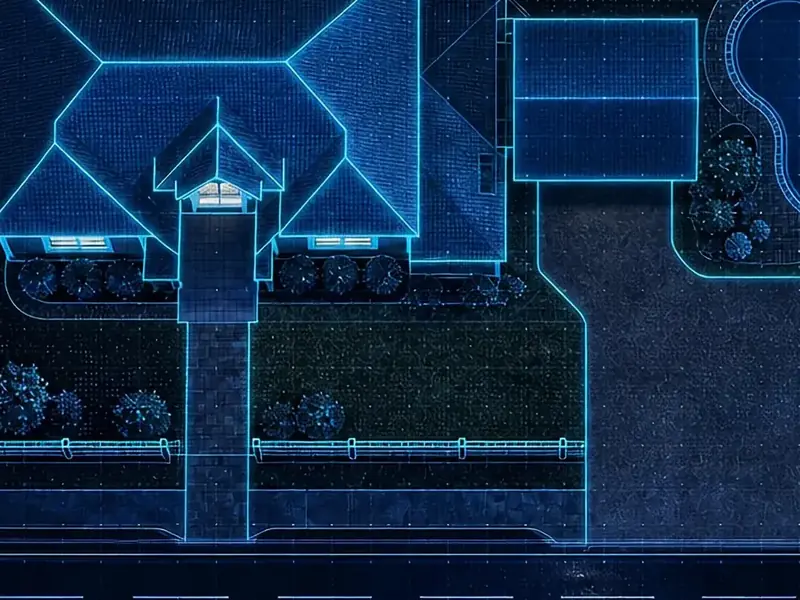
Trace it from above and get the pavers, the base stone, the bedding sand and the joint sand in one list.